

Your kids come back different, and you're the only one who seems to notice
Everyone told you the divorce was the hard part. Then the custody schedule started, and something began happening to your children that you can see clearly and cannot get anyone else to take seriously.
You are not imagining it, and it isn't unnamed. There's a chapter for it, and it starts on page 147.
The signs the book actually lists
These are drawn from the alienation section of Chapter Six, not from us. Check the ones you've seen.
That list isn't ours. It's how Chapter Six describes what alienation looks like from the inside, which means what you're seeing already has a name and a section written about it.
You don't have to read it front to back
The book is eight chapters across three parts. For what you're dealing with, three sections do most of the work, and they're all in Part Two.
Start on 147. Go back to page one later.
Two passages from those pages, unedited
Both are exactly as they appear in the book, from the two pages the list above points at.
What parental alienation actually isp147
It's what happens when one parent takes deliberate, planned steps to isolate their child from the other parent by portraying the other parent as bad through their words and conduct. The endgame is to create suspicion and hostility toward the other parent in the child's mind. Does that sound familiar? This is more common than you may expect and is frequently done by narcissists. Parental alienation is usually a subtle, subconscious programming done on the child by the parent.
Permission to stop trying to co-parentp152
Here's something you may need to hear: co-parenting may be impossible for you if your ex is a narcissist. I'm spelling it out clearly because I've had some people feel guilty for not being able to successfully co-parent with their narc ex. As you might imagine, they kept putting up with their tactics and trying to make peace over and over again 'for the kids'. Needless to say it wasn't very successful at all and led to more stress than good. So please don't feel bad about not co-parenting.
What this book isn't
What it is: a book by a parent who went looking for this and couldn't find it, with a full references section for the research behind it.
The one review worth reading twice
She read it as the grown child of divorced parents, which is the one perspective you cannot get anywhere else.
One book, one decision
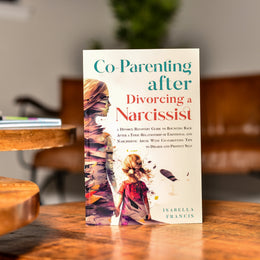
There's a companion workbook and a four-book set if you want them later. See both options
The things that stop people right here
Is it already too late? The patterns feel set.
Chapter Four covers how loyalty conflicts form, how they can affect a child, and how to think about whether therapy is worth considering. The book doesn't promise outcomes, and neither will we.
Will this tell me to fight him or badmouth him to the kids?
No. Chapter Five is about disarming: setting boundaries, staying calm when he's infuriating, and stopping the people-pleasing that keeps you hooked. Chapter Seven is positive co-parenting. None of it asks you to put your kids in the middle.
My kids are teenagers, not little.
Chapter Four has a section on teenagers specifically, on page 104, alongside the questions kids commonly ask and answers to give.
Is this a legal guide for custody?
No, and that's worth being clear about. It covers sorting out legal and financial loose ends after the divorce, but it isn't a litigation manual and doesn't replace your attorney.
Is this only for mothers?
No. The book addresses parents of either gender, and an ex who won't negotiate in good faith isn't specific to one parent.
You're the only one close enough to see it. Page 147 is where someone finally names it.
Add to cart