
The four books
A divorce doesn't happen in one stage. Neither does recovering from one.
Most people arrive here looking for one book and find they are standing in two places at once. These four were written for four different moments. Find the one you are actually in, not the one you think you should be past.
Start here
Which of these sounds like today?
Pick whichever is truest right now. Not the most flattering one, the truest one.
Nothing selected yet. Pick one above and it will show you where to start.
The road
Four stages, and the book written for each one.
They are not volumes one to four. Each stands alone. The order below is the one recovery usually follows, but almost nobody walks it in a straight line.
1
8 chapters


Stage one · The grief
It is still raw, and everyone has stopped asking.
The first months, when the paperwork is done and the feeling is not. Where most people are when they go looking for a book and cannot find one that starts early enough.
You might be here if
Everyone thinks I should be over it by now.
I keep running the reel of what I should have done differently.
I have been kinder to strangers than I have been to myself.
What this one does
Puts the grief first. A Time To Weep is chapter two, A Time To Move On is chapter eight
Addresses The Left versus the Leaver, whichever side you are on
Affirmations and exercises sitting alongside the reading, not instead of it
2
9 chapters


Stage two · The pattern
The marriage ended. The habits followed you out.
The stage where you notice the divorce solved the relationship but not the thing underneath it. Usually arrives once the grief has quietened enough to see clearly.
You might be here if
I still check whether they are upset before I decide how I feel.
Being alone somehow feels worse than being treated badly.
I have rebuilt everything except the part that keeps choosing this.
What this one does
Traces it back through attachment styles, not character or willpower
A full chapter on stopping the obsessive thinking
Independent identity first, healthier relationships built on top of it
3
8 chapters · 8 workbooks


Stage three · The line
You know what you want. Saying it is the problem.
The stage where the work turns outward. You can see the pattern now, and the difficulty is holding a line without the guilt collapsing it by Thursday.
You might be here if
I say yes when everything in me is screaming no.
Every time I hold a line, the guilt arrives before the relief.
I keep bracing for what they will do if I push back.
What this one does
Internal boundaries first, external second, in that order deliberately
Direct about the fear of retaliation and the guilt that follows a line
Eight workbooks printed inside the book, one at the end of every chapter
4
Most read of the four


Stage four · The ex
You are the only one negotiating in good faith.
The stage that never fully ends while there are children involved. Plenty of readers start here rather than finish here, because this is the one that will not wait.
You might be here if
Every attempt to be reasonable gets used against me.
I have been made to feel guilty for not being able to co-parent.
I keep making peace over and over, for the kids.
What this one does
Says plainly that co-parenting may be impossible with a narcissist
Names parallel parenting as the alternative, and when to choose it
Covers parental alienation, loyalty conflicts, and talking to teenagers
Almost nobody is in only one stage.
Grief does not politely finish before the pattern shows up, and an ex who will not cooperate does not wait for you to feel ready. If two of those descriptions fit, that is normal, and it usually means starting with whichever one is loudest this week.
The whole picture
Reading is one half. Doing something with it is the other.
The four books explain what is happening to you. The journal is where you put it down on paper afterwards, on the days when it is still happening.
1Understand what is happening
 The grief
 The pattern
 The line
 The ex
then
2Put it somewhere
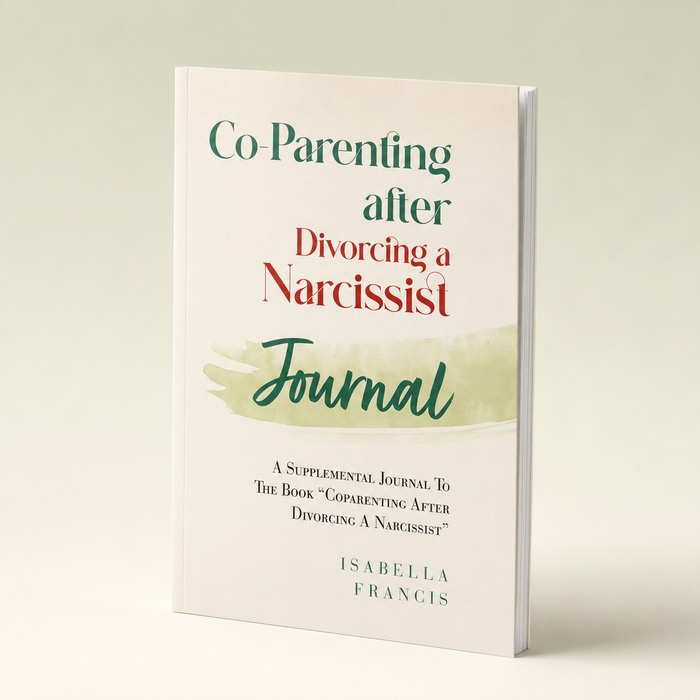
The journal · a guided companion
Co-Parenting After Divorcing A Narcissist: A Companion Workbook
A guided journal built as a practical companion to the co-parenting book. Somewhere to write freely on the evening after the handover went badly, rather than carrying it into the next week.
Pages designed to help you
Process difficult interactions and emotions
Identify patterns and triggers
Set and reinforce healthy boundaries
Track progress and personal growth
Stay grounded and focused on your well-being
Two honest notes on how these pair.The journal was written as a companion to Co-Parenting After Divorcing a Narcissist specifically, so that is the pairing it was designed for. Its prompts on patterns, triggers and boundaries carry over to the other three, but it is not a general-purpose journal for the whole series. And Setting Boundaries does not need it: that book already has eight workbooks printed inside, one at the end of every chapter.
Journal price, title and the five bullet lines are pulled from the live product listing. The pairing note is editorial, written to stop the journal being sold as something it is not.
In more than one stage
Then take the whole road.
The set exists for the reader who recognises themselves in two or three of the stages above, which is most people. Every stage on the shelf means the next book is already there on the night you need it, instead of being another decision to make.
Self-Compassion for Divorce Recovery, for the grief
Codependency Recovery Post-Divorce, for the pattern
Setting Boundaries after a Toxic Divorce, for the line
Co-Parenting After Divorcing a Narcissist, for the ex



The Complete Recovery Set
$76.96
Four paperbacks, shipped together.
Add the complete setPriced the same as buying the four separately. The set exists so you are not deciding again in three weeks.

Why there are four
I could not find one book that covered all of it.
Every book I picked up handled one piece and assumed the rest had been dealt with. The grief books skipped the ex entirely. The co-parenting books started at logistics, as though the grief had been filed away with the paperwork.
So there are four, and they are deliberately separate. You should not have to read three hundred pages about somebody else's stage to reach your own.
Isabella
Written over five years, after a two-year toxic relationship of her own
Before you choose
The questions people ask here.
No. Each one is written to stand alone, with its own opening and its own arc. The numbering describes the stages, not a required sequence. Most readers buy one, then come back for whichever stage arrives next.
That is the normal case rather than the exception. Start with whichever description made you wince most, and treat the second one as the next book rather than a competing choice.
Three of the four apply regardless. Co-Parenting After Divorcing a Narcissist is specifically about raising children with an ex who will not cooperate, so it is the one to skip. The other three deal with grief, pattern, and boundaries, which are not conditional on having kids.
Co-Parenting After Divorcing a Narcissist, by a wide margin. It has 200 verified reviews against a handful across the rest, largely because an uncooperative ex creates urgency that grief does not.
No, and we would rather say so. It is priced at exactly the sum of the four books. It exists for convenience and for having the next stage already on the shelf, not as a discount.
It was written as a companion to Co-Parenting After Divorcing a Narcissist, so that is the pairing it was designed for. The prompts on patterns, triggers and boundaries carry over usefully, but Setting Boundaries already contains eight workbooks of its own.