

For the parent watching it happen
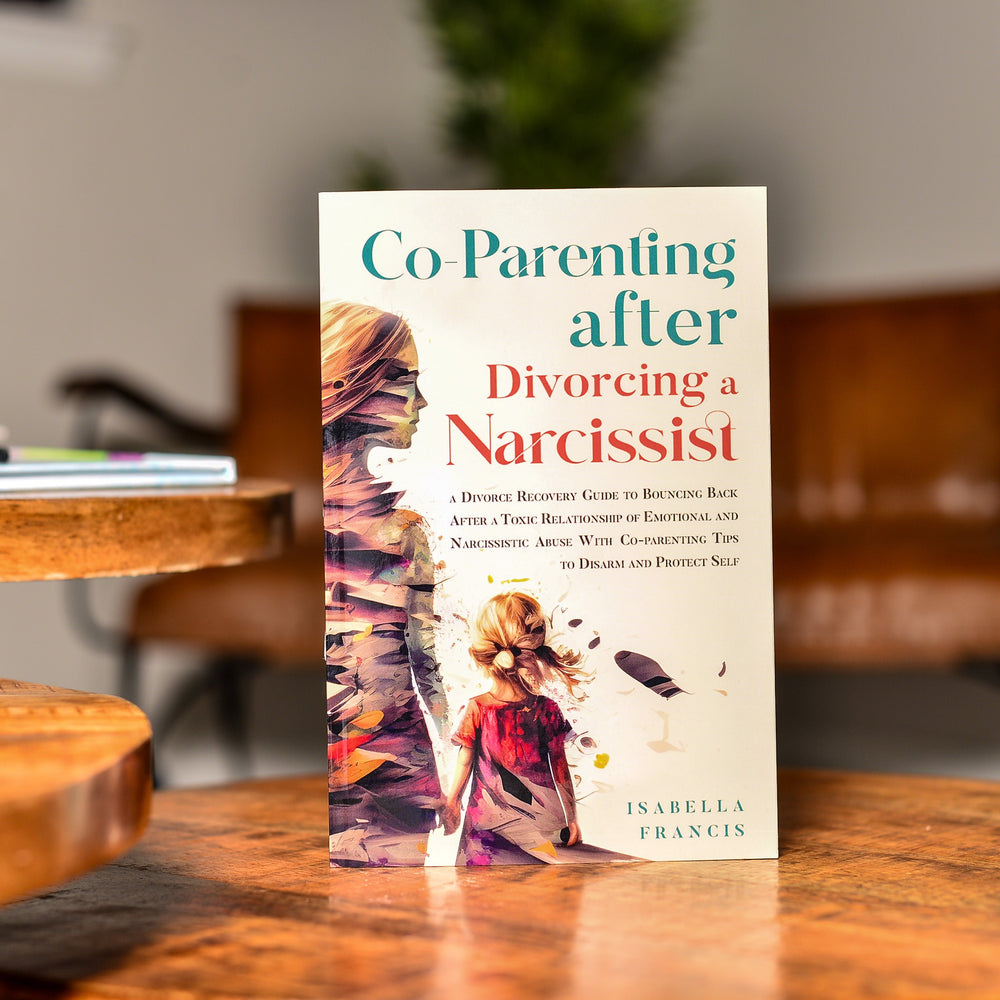
Co-Parenting After Divorcing a Narcissist
The book for the part nobody warned you about: when the divorce ends and the campaign moves to your kids.
- What loyalty conflict looks like in a child, and how parents cause it
- Parental alienation named plainly, with the signs to watch for
- When to stop trying to co-parent and choose parallel parenting
- How to talk to your kids about it, including teenagers
Choose how you start
- The complete book, all eight chapters
- Ships in 3 to 5 days
- No prompts or exercises to work through
- The complete book, all eight chapters
- Prompts and exercises to work through on paper
- This book, plus Boundaries, Self-Compassion, Codependency
- Clears the free shipping threshold
WELCOME10 applies at checkout · ships in 3 to 5 days · free shipping over $75
Before anything else
The divorce was the part everyone prepared you for
You had a lawyer. Maybe a mediator. People told you the hard part was the paperwork, and that once it was signed you could start over.
Then the first exchange happened. Then a message arrived that read perfectly reasonable to everyone except you. Then your kid came home saying something that didn't sound like your kid.
Nobody explains that the conflict doesn't end. It relocates. Into the schedule. Into the handoffs. Into how they talk about you when you're not in the room.
This book was written for that part.
Why the usual advice keeps failing you
Every co-parenting book assumes two cooperative parents
The standard playbook
Communicate more. Stay flexible. Set your differences aside for the children. Meet in the middle and keep the peace.
All of it rests on one assumption, that both adults want the same outcome and are negotiating toward it in good faith.
When that assumption doesn't hold, the advice doesn't just fail. It hands the other parent the lever. Every concession reads as an opening. Every attempt to keep the peace becomes the next thing to be extracted.
What this book does instead
It starts from the opposite premise: that cooperation may simply not be available to you, and that this is not a failure on your part.
It says so in print, on page 152, and then spends the rest of the chapter on what replaces it. Parallel parenting isn't presented as giving up. It's presented as the realistic structure for sharing custody with someone who won't negotiate.
Most readers arrive here already doing a version of it. The book gives it a name and a shape.
The breakdown
The practical shape of it
Before the argument, the facts, so you know what you'd actually be holding.
Format
Paperback, 6 by 9, 196 pages
Structure
Eight chapters in three parts, readable out of order
Start at
Page 147, not page one
Not for
Custody strategy. It isn't a legal guide.
The actual table of contents
You can see exactly what you're getting
Nothing here is paraphrased marketing. This is the contents page, reproduced with the real page numbers.
How to read it
Three sections do most of the work
All three sit in Part Two. You can come back to the rest later.
Parental Alienation is a Thing
What it actually is, how subtle it usually is, and the signs it's happening.
How Parents Cause Loyalty Conflict
Including the ways well-meaning parents create it without realising.
When To Choose Parallel Parenting Instead
The decision to stop chasing cooperation, and what replaces it.
Verbatim from Chapter Six
The line most co-parenting books won't print
“Here's something you may need to hear: co-parenting may be impossible for you if your ex is a narcissist. I'm spelling it out clearly because I've had some people feel guilty for not being able to successfully co-parent with their narc ex.”Isabella Francis · Chapter Six, page 152
Verbatim from Chapter Five
And the line that explains why he still gets to you
“Disarming a narcissist is all about you, not them.”
Isabella Francis · Chapter Five, page 120
What follows that line is the mechanism the rest of the chapter runs on. He isn't reacting to you at random. Your reaction is the thing he's after, and it's the one part of the exchange you control. Chapter Five is about removing it from the equation, and it runs from the psychology behind the behaviour through boundaries, staying calm when he's provoking you, and dropping the people-pleasing that keeps you engaged.
Against what you keep hearing
Everyone tells you to wait it out
| What you keep getting told | What this book says |
|---|---|
| They're just adjusting to two homes | Loyalty conflict has a name and a section of its own |
| Don't read into what they say | Parental alienation is a thing, stated plainly |
| Never say anything that could upset them | Gives the questions kids ask, and answers to give |
| Keep trying to co-parent for their sake | Names when to choose parallel parenting instead |
| Teenagers are just like that | Teenagers get their own section, page 104 |
Who wrote this
Isabella Francis

Isabella Francis writes about narcissistic abuse because she came out the other side of a two-year toxic relationship and found there was almost nothing useful to read.
She's spent the last five years writing about recovery, and her books cover the whole arc of it: spotting a toxic relationship early, ending one, healing from the trauma afterwards, and protecting your children's mental health while you do. She writes that personal boundaries, clarity of purpose and mindfulness are the three things recovery actually rests on.
She lives on a ranch in California with her husband and three daughters.
“We all deserve a chance at a normal life and healthy relationships even if we have been hurt before.”
The last few questions
Before you decide
Why the paperback and not the eBook?
What's in the Companion Workbook?
What if my ex hasn't been diagnosed?
How fast does it arrive, and what if it isn't right?
From readers
Real reviews, filtered by the doubt they answer
I love how sometimes we don't even realize that we are dealing with a narcissist, so we don't know how they act. But in this book, you get tests and red flags of proper behavior of a narcissist to help you best prepare and understand what and how to find common ground for the children.
Whether divorcing a diagnosed narcissist or a particularly difficult partner, Isabella Francis provides readers with important tools to navigate a situation that can wear down even the strongest individuals.
Having a lot of experience in divorce court I can say that this book has a lot of great information. If you are going through a divorce with a narcissist, then I highly recommend.
One last thing
You're the only one close enough to see it
Page 147 is where someone finally names it.
Add to cart